
SETTING UP A FOREIGN-OWNED BUSINESS IN VIETNAM: WHAT DOES DECREE 393/2026/ND-CP CHANGE FOR THE WORK PERMITS OF FOREIGN CHEFS, TEACHERS AND STYLISTS FROM 5 DECEMBER 2026?
Many foreign-owned businesses rely on at least one foreign employee, such as a head chef for a restaurant, an English teacher for a language center, or a senior stylist for a salon. Getting the work permit right is part of setting up the business, because working without the right permit or exemption can disrupt operations.
On 20 October 2026 the Government issued Decree No. 393/2026/ND-CP on foreign nationals working in Vietnam. According to an alert by the law firm Duane Morris published on Legal 500 on 19 November 2026, the decree takes effect on 5 December 2026, replaces Decree No. 219/2025/ND-CP and supersedes specified provisions of Resolution No. 24/2026/NQ-CP.
So what changes for a foreign-owned business, which deadlines does an employer need to add to its calendar, and what should be done before 5 December?

If you are interested in foreign-invested company setup services in Vietnam, please contact Dai Quang Minh Company at Zalo/Hotline: 0932.191.299; Email: info@quangminhlawfirm.com; Viber: (+84) 329 656 280; WhatsApp: (+84) 329 656 280; WeChat: (+84) 329 656 280 (ID: daiquangminh123) for free, complete, fast and accurate support.
In addition, Dai Quang Minh Company provides customers with services in other sub-licences; business registration; investment; foreign labour; and ongoing advisory for the operations of businesses in Vietnam and abroad.
Contact:
- Zalo: 0932.191.299
- Gmail: info@quangminhlawfirm.com
- Viber: (+84) 329 656 280
- WhatsApp: (+84) 329 656 280
- WeChat: (+84) 329 656 280 (ID: daiquangminh123)
- Telegram: (+84) 329 656 280
I. Setting up a foreign-owned business in Vietnam: What Decree 393/2026/ND-CP Changes
Based on the Duane Morris alert, the main changes for employers are as follows:
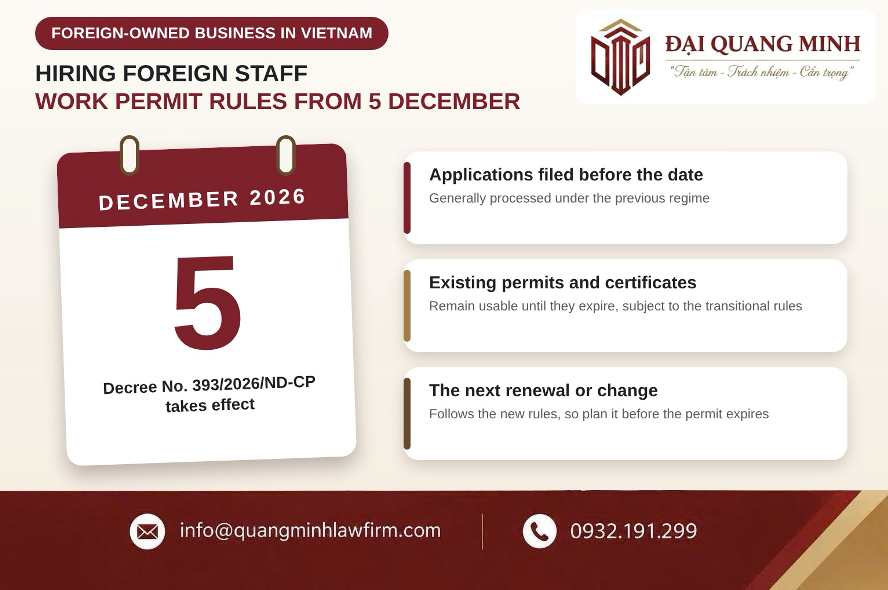
Transition: Applications submitted before 5 December 2026 are generally processed under the previous regime. Permits and exemption certificates validly issued under the previous framework generally remain usable until they expire. The bigger risk is the next extension, reissuance or change of position, which will follow the new rules.
More exemptions: The number of work permit exemption categories rises from 15 to 18. New pathways include foreign experts in designated strategic technologies, professionals recruited under the national AI human resources programme, qualified academics, professors, researchers and STEM specialists, certain master's degree and PhD holders carrying out teaching or research, and holders of qualifying special visa-exemption cards.
Do not assume a category fits: These exemptions are aimed at technology, research and education specialists. A chef, a stylist or a language teacher should not assume that an exemption applies, and the exact category and qualifications must be checked before hiring. An exemption also does not remove every certification, notification or immigration obligation.
Intra-company transfers: The exemption for transfers within a corporate group is narrowed to managers, executives and experts who have been employed by the overseas enterprise for at least 12 consecutive months. Technical workers are no longer included in that category.
Expert qualifications: Qualification routes include a university degree with at least two years of relevant professional experience, or at least five years of relevant experience under an alternative route. The experience requirement for certain executive director classifications is reduced from three years to two years.
II. Setting up a foreign-owned business in Vietnam: New Deadlines, the 90-Day Rule and a Practical Example
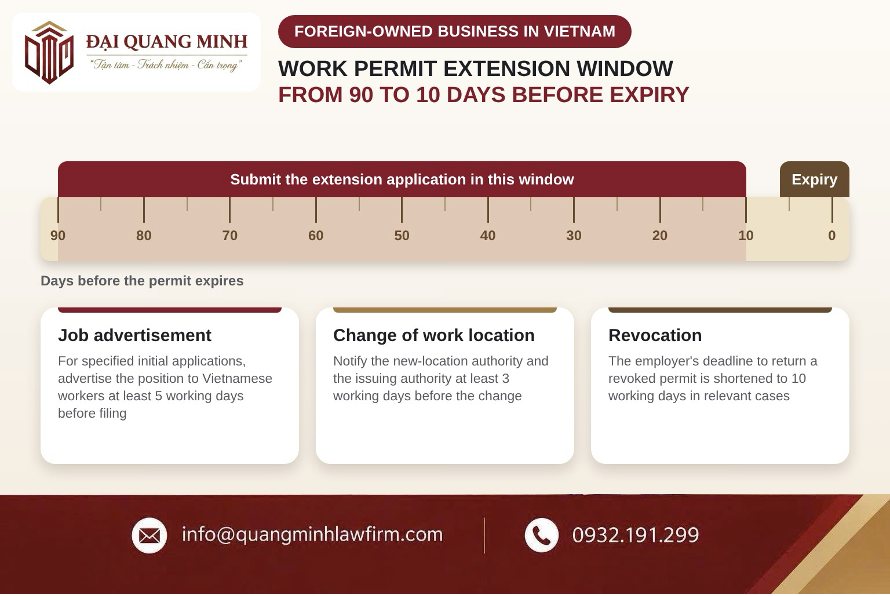
Recruitment advertising: For specified initial work permit applications, the employer must advertise the position to Vietnamese workers at least five working days before filing, unless an exception applies.
Change of work location: Where a foreign worker changes work location under the same employer, notifications may be required to both the new-location authority and the original issuing authority at least three working days before the change.
Reissuance: Changes involving the employer's offices or operating locations can trigger the reissuance of work permits or exemption certificates.
Extensions: An extension application must be submitted within a window of 10 to 90 days before the permit expires. Where an extended permit is approaching expiry, a fresh application may be required within a window of 10 to 60 working days.
Revocation: The decree revises the grounds for revocation and shortens the employer's deadline to return a revoked permit to 10 working days in relevant circumstances.
The 90-day rule: Managers, executive directors, experts and technical workers may fall under the short-term exemption where their cumulative work in Vietnam does not exceed 90 days in a calendar year, counting work for one or more Vietnamese employers. The exemption cannot simply be relied on where a local employment, hiring or wage relationship arises.
Digital checks: Employers may benefit from database-linked verification of criminal records and other supporting information where the authorities can retrieve the data.
Practical example: A foreign-owned restaurant plans to open a second branch in another province and move its foreign head chef there. The owner checks the chef's classification and existing permit, adds the notification to both authorities at least three working days before the move to the HR calendar, and records when the permit expires so that the extension is filed inside the 10 to 90 day window. The owner also checks whether the change of location triggers reissuance of the permit.
Why should customers choose Dai Quang Minh Company?
Human resources: A team of corporate legal experts and project legal specialists with many years of experience at leading domestic private economic groups and large foreign-invested enterprises operating in Vietnam.
Consulting policy: Customers receive a completely free legal consulting package when using the Company's services.
Professionalism and experience: Our staff have deep expertise in business establishment, ensuring a fast, accurate and effective consulting process.
Time savings: Using our services saves you time because all related procedures and documents are handled as a full package.
Legal compliance: We ensure that every process strictly complies with current regulations.
Flexibility: Our consulting services are tailored to the specific needs of each client, helping you choose the optimal solution for your business.
Trusted partner: Dai Quang Minh Company has built a reputation for providing company-formation consulting at reasonable cost for many individuals and businesses nationwide.
Information security: We are committed to absolute confidentiality of our clients' personal and business information.
Detailed support: We provide complete guidance on processes and requirements, helping clients understand every step of establishing a business.
Process optimization: We help simplify the business registration process, minimizing risks and difficulties that may arise.
Customer experience: We always aim to deliver the best experience through professional advice and dedicated support.
Focus on business growth: When you use our services, you can focus on your core business without worrying about legal procedures.
III. Setting up a foreign-owned business in Vietnam: A Quick Checklist before 5 December 2026
List every foreign worker: Record each foreign employee, secondee and short-term assignee, with the permit or exemption they hold and its expiry date.
Confirm the classification: Check whether each person is a manager, executive director, expert or technical worker, and whether the qualifications still fit under the new decree.
Review exemptions carefully: Do not rely on a new exemption category unless the person and the activity clearly match it.
Review intra-company transfers: Check the 12 months of overseas employment for managers, executives and experts, and plan for technical workers who no longer fit that category.
Update the HR calendar: Add the five working day advertisement, the three working day location notice, the 10 to 90 day extension window and the 10 working day return deadline.
Track the 90 days: Keep a central record of workdays, contracts, pay and the Vietnamese entities that receive the services of short-term visitors.
Coordinate with corporate changes: Before opening a branch or moving staff, check whether the change affects work permits or exemption certificates.
Verify the sources: The summary we reviewed is a law firm alert and is not legal advice. Read the full text of Decree No. 393/2026/ND-CP and the transitional provisions before you file.
In short, Decree No. 393/2026/ND-CP widens some exemptions, narrows others and adds deadlines that employers must track. A foreign-owned business that reviews its foreign staff and updates its HR calendar before 5 December 2026 avoids surprises at the next renewal.
If you are interested in foreign-invested company setup services in Vietnam, please contact Dai Quang Minh Company at Zalo/Hotline: 0932.191.299; Email: info@quangminhlawfirm.com; Viber: (+84) 329 656 280; WhatsApp: (+84) 329 656 280; WeChat: (+84) 329 656 280 (ID: daiquangminh123) for free, complete, fast and accurate support.
In addition, Dai Quang Minh Company provides customers with services in other sub-licences; business registration; investment; foreign labour; and ongoing advisory for the operations of businesses in Vietnam and abroad.
Contact:
- Zalo: 0932.191.299
- Gmail: info@quangminhlawfirm.com
- Viber: (+84) 329 656 280
- WhatsApp: (+84) 329 656 280
- WeChat: (+84) 329 656 280 (ID: daiquangminh123)
- Telegram: (+84) 329 656 280
If you have any questions or need support during your operations, please contact Dai Quang Minh Company. We are always ready to support and accompany you in building, operating and growing your business.
We wish you sustainable growth and breakthrough success.
Thank you very much.
BÀI VIẾT LIÊN QUAN:
Bình luận: