
HOW TO SET UP A FOOD MANUFACTURING COMPANY IN VIETNAM: A LEGAL GUIDE FOR FOREIGN INVESTORS
Vietnam’s food manufacturing sector continues to attract strong interest from foreign investors due to the country’s growing domestic consumption, competitive production costs, abundant agricultural resources, and expanding export opportunities. From packaged foods, beverages, sauces, spices, confectionery, bakery products, frozen foods, processed seafood, dairy products, and agricultural products to private-label manufacturing and export-oriented processing, Vietnam offers a wide range of opportunities for food manufacturers.
However, setting up a food manufacturing company in Vietnam is not simply a matter of establishing a company, renting a factory, and starting production. Food manufacturing is a highly regulated business sector because it directly affects public health and consumer safety. Investors must carefully review investment registration, enterprise registration, factory location, food safety conditions, product declaration, product testing, labeling, environmental compliance, fire prevention and fighting, labor safety, import of raw materials, export of finished products, and ongoing inspection requirements.
Under Vietnam’s Law on Food Safety, food safety regulations cover conditions for food production and trading, food import and export, food advertisement and labeling, food testing, food safety risk prevention, and responsibilities for state management of food safety. In addition, Decree 15/2018/ND-CP provides detailed rules on product self-declaration, product declaration registration, certificate of food safety eligibility, state inspection of imported and exported foods, food labeling, and food advertisement.
Prospective clients seeking assistance with procedures for setting up a food manufacturing company in Vietnam are kindly invited to contact Dai Quang Minh Law Firm via Hotline: 0932 191 299; Zalo: 0932 191 299; Email: info@quangminhlawfirm.com; Viber: (+84) 337 926 405; WhatsApp: (+84) 337 926 405; WeChat: (+84) 337 926 405 (ID: pouniverse) for complimentary consultation and comprehensive, efficient, and accurate legal services.
In addition, Dai Quang Minh Law Firm provides a wide range of services, including sub-licenses, business registration, investment, foreign labor, and ongoing legal advisory services for both domestic and foreign enterprises.
Contact:
- Zalo: 0932.191.299
- Gmail: info@quangminhlawfirm.com
- Viber: (+84) 337926405/ (+84) 869672216
- WhatsApp: (+84) 337926405/ (+84) 869672216
- Wechat: (+84) 337926405 (ID: _pouniverse)/ (+84) 869672216 (ID: DQM_Verna)
- Telegram: (+84) 337926405/ (+84) 869672216
1. UNDERSTANDING THE LEGAL MODEL OF A FOOD MANUFACTURING BUSINESS IN VIETNAM
The first step is to identify the actual food manufacturing model that the investor intends to operate. Not all food production activities are regulated in the same way. A company manufacturing packaged food, bottled drinks, confectionery, sauces, spices, frozen foods, canned foods, processed seafood, dairy products, functional foods, food additives, or animal-origin products may be subject to different legal requirements depending on the type of product and production process.
This distinction is important because food manufacturing is not a single uniform licensing category. Different products may fall under the management of different authorities and may require different compliance steps. For example, ordinary packaged food may follow product self-declaration procedures, while certain special food products may require product declaration registration before being placed on the market. Decree 15/2018/ND-CP specifically regulates both product self-declaration and registration of product declarations.
Foreign investors should also determine whether the company will manufacture food for domestic sale, export, private-label production, contract manufacturing, or internal processing for another enterprise. The legal roadmap may vary depending on whether the products are sold in Vietnam, exported only, imported as raw materials, or manufactured under another brand owner’s specifications.
A food manufacturing project should therefore be planned from the product level, not only from the company registration level. Before signing a lease or building a factory, investors should identify the exact food products, production scale, raw materials, machinery, warehouse conditions, target market, labeling requirements, and product declaration obligations.

2. SETTING UP A FOREIGN-INVESTED FOOD MANUFACTURING COMPANY
As with most foreign-invested manufacturing projects in Vietnam, the investor must first establish a lawful business vehicle. In many cases, this involves applying for an Investment Registration Certificate and then obtaining an Enterprise Registration Certificate before commencing post-establishment licensing and operational preparation.
The company’s registered business lines should accurately reflect the intended food manufacturing activities. These may include production of specific food products, processing of agricultural products, production of beverages, manufacture of packaged food, or other related activities. If the company also intends to import raw materials, distribute finished products, operate warehouses, conduct retail or wholesale distribution, or export products, these activities should be reviewed and registered appropriately.
The factory location is one of the most important issues. Unlike consulting or trading companies, a food manufacturer cannot usually operate from an ordinary office address. The investor must consider whether the factory is located in an industrial zone, export processing zone, food production cluster, or other lawful production site. The lease agreement, land use purpose, construction condition, fire safety status, environmental compliance, waste treatment capacity, water supply, drainage system, and logistics access should all be reviewed before committing to the premises.
For foreign investors acquiring or contributing capital to an existing food production company, legal due diligence is essential. The investor should review the enterprise registration certificate, investment registration certificate if any, land or factory lease documents, construction documents, food safety certificate, product declarations, environmental documents, fire safety records, labor compliance, tax filings, supplier contracts, distribution contracts, intellectual property, product liability history, and any past inspection or sanction records.
WHY CHOOSE DAI QUANG MINH LAWFIRM
With years of practical experience in legal consulting, Dai Quang Minh Law Firm is a pioneer in corporate support services, specializing in fast and affordable company formation. Below are the reasons to choose business registration services at Dai Quang Minh Law Office:
Human Resources: Established in September 2009, with over 15 years of practical experience, Dai Quang Minh Law Firm brings together a team of lawyers and legal experts with long-standing expertise in private economic groups nationwide.
Consulting Policy: Clients are gifted a completely free legal consulting package when using services at Dai Quang Minh Law Firm.
Professionalism and Experience: Dai Quang Minh Law Firm has a workforce with in-depth knowledge of business formation, ensuring a swift and accurate consulting process.
Time-Saving: Using Dai Quang Minh Law Firm's services helps you save precious time as we handle the entire process and related procedures.
Legal Insight: Dai Quang Minh Law Firm ensures that all relevant legal regulations are strictly followed in accordance with the law.
Customization: Our consulting services are highly adaptable to your specific needs, allowing you to choose options suitable for your business.
Trusted Partner: Dai Quang Minh Law Firm has built a reputation for providing affordable business setup consulting to many enterprises and individuals nationwide.
Confidentiality Assurance: Dai Quang Minh Law Firm is committed to the absolute protection of your personal and business information.
Detailed Support: Dai Quang Minh Law Firm provides detailed advice and support regarding the process and requirements to help you better understand business formation.
Process Optimization: Our consulting helps optimize the business setup process, minimizing potential risks and difficulties.
Excellent Customer Experience: Dai Quang Minh Law Firm is dedicated to providing the best customer experience through professional advice and enthusiastic support.
Focus on Business Plans: By utilizing our registration services, you can focus on developing your business plans and core activities instead of worrying about legal procedures.

3. CORE LICENSES AND COMPLIANCE REQUIREMENTS FOR A FOOD MANUFACTURING COMPANY
After the legal model is determined, the investor should identify the main licenses and compliance requirements for lawful operation. A food manufacturing company may need several legal steps rather than one simple business registration.
3.1. Investment registration and enterprise registration
For many foreign-invested food manufacturing projects, investment registration is an important initial stage. The investor should prepare information on the investor’s legal status, proposed project, investment capital, factory location, production scale, machinery, technology, implementation timeline, labor plan, and environmental impact.
The investment registration stage allows the competent authority to review whether the proposed project is permitted, whether the factory location is suitable, whether the project scale is consistent with the investment plan, and whether additional approvals may be required. For food manufacturing, this review may be closely connected with factory location, environmental compliance, and land or lease documents.
After the investment structure is approved, the investor establishes the company and obtains the Enterprise Registration Certificate. The company should then complete tax registration, bank account opening, capital contribution, accounting setup, e-invoice registration, and other post-establishment procedures.
3.2. Certificate of food safety eligibility
A Certificate of Food Safety Eligibility is one of the most important approvals for food manufacturing establishments. Under Decree 15/2018/ND-CP, food production or trading establishments must generally have a certificate of food safety eligibility when operating, except for specific exempted cases.
The Law on Food Safety provides that establishments must satisfy food safety conditions appropriate to each type of food production and business and must have registered food-related business activities in their business registration documents. In practice, food safety review may cover the production area, storage area, water source, equipment, production process, waste handling, pest control, cleaning procedures, personnel hygiene, health requirements, and internal food safety management system.
Investors should not wait until the factory is fully built before reviewing food safety feasibility. If the production layout, raw material flow, finished product storage, washing area, drainage system, or waste treatment area is designed incorrectly, the company may need to spend additional time and cost to modify the factory before obtaining approval.
Certain establishments may be exempted from obtaining a Certificate of Food Safety Eligibility, depending on their scale or business model. However, exemption from the certificate does not mean exemption from food safety obligations. Even exempted entities must still comply with applicable food safety requirements.
3.3. Product self-declaration and product declaration registration
Before food products are placed on the Vietnamese market, the company should determine whether the products are subject to self-declaration or registration of product declaration.
Under Decree 15/2018/ND-CP, many ordinary packaged foods are subject to product self-declaration. The enterprise prepares the self-declaration dossier, keeps relevant documents, and publishes the declaration in accordance with applicable procedures. Where there is any change in a product’s name, origin, or ingredients, a new self-declaration may be required.
Certain products, however, may require registration of product declaration before circulation. These may include specific types of food products subject to stricter regulatory control, such as health supplements, medical nutrition products, food for special dietary uses, and certain products for children, depending on applicable regulations. Decree 15/2018/ND-CP contains procedures for registration of product declarations as a separate category from self-declaration.
Product testing is also important. Food safety test results from an accredited or designated testing body are commonly required as part of product declaration procedures. Investors should plan product testing early because product formulation, ingredients, shelf life, and labeling may need to be adjusted based on test results.
3.4. Food labeling and packaging compliance
Food labels must comply with Vietnam’s goods labeling rules and food safety regulations. Decree 111/2021/ND-CP amends Vietnam’s goods labeling framework and deals with information on goods labels, label presentation, and state management of labels for goods circulated in Vietnam, exported goods, and imported goods.
For food products, label review is especially important because labels may need to show information such as product name, ingredients, quantity, production date, expiry date, storage instructions, origin, manufacturer information, importer or distributor information where applicable, warnings, nutrition information, and other mandatory details depending on the product type.
Investors should not print packaging before legal review. Incorrect labels may cause delays in product circulation, product recall risks, administrative penalties, or the need to reprint packaging. For imported raw materials and exported finished products, the company should also check labeling requirements of the destination market.
3.5. Factory, environmental and fire safety compliance
Food manufacturing projects may involve wastewater, solid waste, odors, heat, refrigeration systems, boilers, gas, chemicals, packaging waste, and other environmental or fire safety issues. Therefore, factory compliance should be reviewed together with food safety compliance.
Vietnam’s Law on Environmental Protection 2020 applies to organizations and individuals within Vietnam and provides the legal framework for environmental protection obligations. Depending on the scale, production process, and environmental impact of the project, the company may need to prepare environmental registration, an environmental impact assessment, an environmental license, waste treatment arrangements, or other environmental documents.
Fire prevention and fighting compliance is also important. Food factories may use electrical systems, production machinery, heating equipment, refrigeration systems, packaging materials, storage warehouses, and flammable substances. The investor should review fire safety requirements at the design and fit-out stage rather than after the factory is completed.
3.6. Import of raw materials and export of finished products
Many food manufacturing companies import raw materials, additives, flavorings, packaging materials, machinery, or semi-finished products. Others manufacture products in Vietnam for export. These activities may involve customs procedures, HS code classification, import duties, value-added tax, specialized inspection, quarantine, certificate of origin, and compliance with destination market requirements.
Decree 15/2018/ND-CP also covers state inspection of food safety for imported and exported foods. Therefore, investors should plan import and export compliance early, especially if raw materials are animal-origin products, seafood, agricultural products, additives, or products subject to quarantine or specialized inspection.
For export-oriented food production, the company should review the food safety standards of the destination country. Requirements may differ significantly for the United States, European Union, Japan, South Korea, China, Australia, and other markets. Export contracts should also address product specifications, inspection, delivery terms, liability for non-conforming goods, recall obligations, and governing law.
3.7. Labor, hygiene training and internal compliance
Food manufacturing companies must also comply with general labor obligations, including labor contracts, working hours, wages, social insurance, occupational safety, and internal workplace rules where applicable. If foreign managers, technical experts, production specialists, or quality-control personnel work in Vietnam, work permit or work permit exemption requirements should be reviewed.
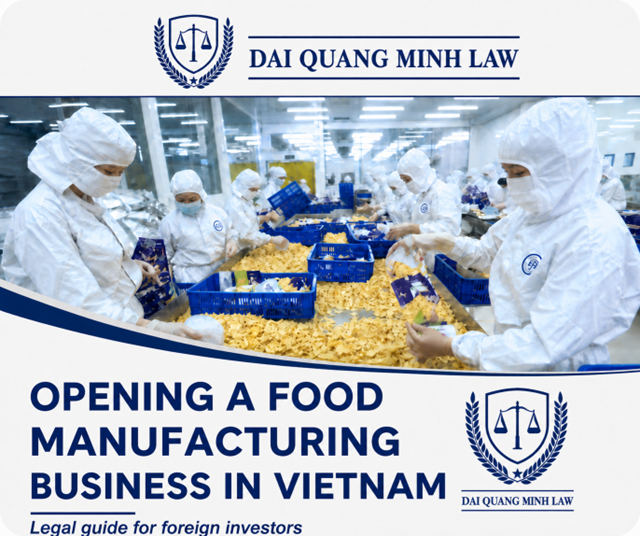
Internal hygiene and food safety training are also important. Workers involved in food production should understand hygiene procedures, protective clothing requirements, contamination risks, cleaning processes, storage rules, and reporting procedures for food safety incidents.
A food manufacturing company should maintain proper internal records, including supplier records, production batches, testing results, product declarations, cleaning logs, pest control records, warehouse records, complaint records, recall procedures, and inspection documents. These records are important not only for compliance but also for quality control and customer trust.
4. PRACTICAL LEGAL CONSIDERATIONS BEFORE LAUNCHING A FOOD MANUFACTURING BUSINESS
Before launching a food manufacturing company in Vietnam, foreign investors should review several practical legal issues.
First, the investor should identify the exact product category. Different food products may be subject to different authorities, declaration procedures, food safety requirements, testing standards, and labeling rules.
Second, the investor should check the factory location before signing a long-term lease. The premises should be suitable for food manufacturing, business registration, food safety approval, environmental compliance, fire safety, logistics, and warehouse operation.
Third, the production layout should be reviewed early. Raw material intake, processing, packaging, finished product storage, waste handling, staff movement, and cleaning areas should be arranged to reduce contamination risks and support licensing approval.
Fourth, the company should determine whether the product is subject to self-declaration or product declaration registration. Product testing and declaration should be planned before commercial circulation.
Fifth, labels and packaging should be legally reviewed before printing. Mistakes in product name, ingredients, origin, expiry date, warnings, nutrition information, or manufacturer details may create significant compliance risks.
Sixth, supplier and distribution contracts should be carefully drafted. Food manufacturing depends heavily on raw material quality, packaging standards, delivery schedules, storage conditions, product liability, recall obligations, and payment terms.
Seventh, the company should register and protect its trademark early. For food products, brand identity, packaging design, product names, and distribution channels are commercially important and should be protected before market launch.
Eighth, the company should prepare for inspections. Food manufacturers may be inspected by competent authorities, and proper records can help demonstrate compliance with food safety, labeling, environmental, labor, and tax obligations.
Overall, setting up a food manufacturing company in Vietnam is legally feasible and commercially promising for foreign investors. However, the sector requires careful planning because food safety, factory compliance, product declaration, labeling, environment, import-export, and consumer protection issues are closely connected. A clear legal roadmap can help investors reduce licensing delays, avoid product circulation risks, and build a compliant and sustainable food manufacturing business in Vietnam.
Prospective clients seeking assistance with procedures for setting up a food manufacturing company in Vietnam are kindly invited to contact Dai Quang Minh Law Firm via Hotline: 0932 191 299; Zalo: 0932 191 299; Email: info@quangminhlawfirm.com; Viber: (+84) 337 926 405; WhatsApp: (+84) 337 926 405; WeChat: (+84) 337 926 405 (ID: pouniverse) for complimentary consultation and comprehensive, efficient, and accurate legal services.
In addition, Dai Quang Minh Law Firm provides a wide range of services, including sub-licenses, business registration, investment, foreign labor, and ongoing legal advisory services for both domestic and foreign enterprises.
Contact:
- Zalo: 0932.191.299
- Gmail: info@quangminhlawfirm.com
- Viber: (+84) 337926405/ (+84) 869672216
- WhatsApp: (+84) 337926405/ (+84) 869672216
- Wechat: (+84) 337926405 (ID: _pouniverse)/ (+84) 869672216 (ID: DQM_Verna)
- Telegram: (+84) 337926405/ (+84) 869672216
Bình luận: