
FOREIGN‑OWNED BUSINESS ESTABLISHMENT SERVICES (2026): ESTABLISHING A FOREIGN-INVESTED BEVERAGE MANUFACTURING COMPANY IN VIETNAM
Vietnam’s beverage market covers a wide range of products, including bottled drinking water, natural mineral water, soft drinks, fruit juices, bottled tea, bottled coffee, energy drinks, nutritional beverages, beer, wine, spirits and other alcoholic beverages. For foreign investors, establishing a beverage manufacturing company in Vietnam is not merely a company registration matter. It also involves investment licensing, food safety, product declaration, labeling, environmental compliance, fire prevention and firefighting, and, in some cases, special permits for alcoholic beverages.
The first legal issue is to identify exactly what type of beverage the investor intends to manufacture. A factory producing bottled water or non-alcoholic soft drinks will not follow the same legal path as a factory producing wine, spirits, beer or other alcoholic beverages. If the business model is not correctly structured from the beginning, the investor may face difficulties during investment registration, factory setup, food safety licensing, product declaration and market circulation.
Prospective clients seeking assistance with procedures for setting up a foreign-invested beverage manufacturing company in Vietnam are kindly invited to contact Dai Quang Minh Company via Hotline: 0932 191 299; Zalo: 0932 191 299; Email: info@quangminhlawfirm.com; Viber: (+84) 337 926 405; WhatsApp: (+84) 337 926 405; WeChat: (+84) 337 926 405 (ID: pouniverse) for complimentary consultation and comprehensive, efficient, and accurate legal services.
In addition, Dai Quang Minh Company provides a wide range of services, including sub-licenses, business registration, investment, foreign labor, and ongoing legal advisory services for both domestic and foreign enterprises.
Contact:
- Zalo: 0932.191.299
- Gmail: info@quangminhlawfirm.com
- Viber: (+84) 337926405/ (+84) 869672216
- WhatsApp: (+84) 337926405/ (+84) 869672216
- Wechat: (+84) 337926405 (ID: _pouniverse)/ (+84) 869672216 (ID: DQM_Verna)
- Telegram: (+84) 337926405/ (+84) 869672216
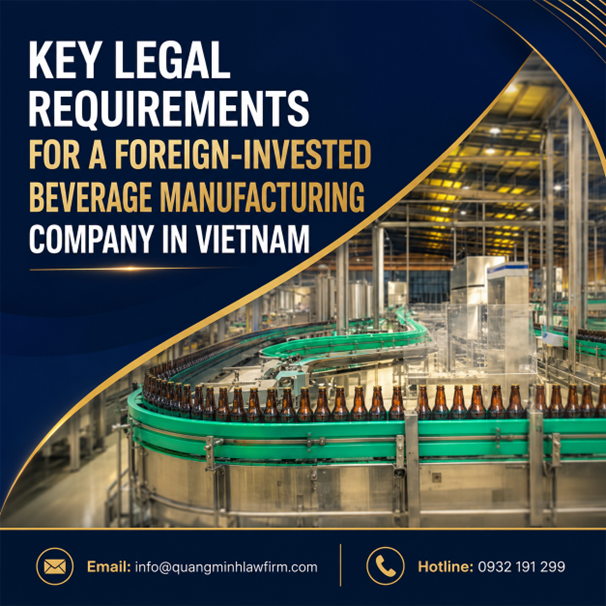
I. FOREIGN INVESTOR MARKET ACCESS AND INVESTMENT REGISTRATION
Under Vietnam’s investment law, investors may conduct business activities in sectors that are not prohibited by law. For conditional business lines, investors must satisfy the applicable conditions. Foreign investors must also review market access conditions applicable to their proposed business lines. The 2025 Law on Investment and Decree No. 96/2026/ND-CP provide the current framework for investment activities and foreign investor market access in Vietnam.
In practice, many ordinary beverage manufacturing activities, such as producing bottled water, bottled tea, coffee drinks, fruit beverages or non-alcoholic soft drinks, may be considered feasible for a foreign-invested company. However, the investor must still clarify the product line, formula, raw materials, production process, production capacity, factory location, machinery, labor demand and environmental impact.
For alcoholic beverages, the legal review must be more careful. Alcohol business in Vietnam is regulated under Decree No. 105/2017/ND-CP on alcohol trading, which covers alcohol production, distribution, wholesale, retail, import and on-premise consumption activities.
Normally, a foreign investor establishing a beverage manufacturing project must register the investment project and establish a Vietnamese enterprise. The investment dossier should clearly state the project objectives, investment capital, factory location, production scale, machinery and equipment, implementation schedule and environmental matters. If the project is located in an industrial park, the investor should also check whether the proposed manufacturing activity is suitable for the approved planning and environmental capacity of that industrial park.

II. ESTABLISHMENT OF THE VIETNAMESE COMPANY AND BUSINESS SCOPE
After completing the required investment procedure, the investor establishes the Vietnamese project company. Common forms include a single-member limited liability company, a multi-member limited liability company or a joint stock company.
The company’s registered business lines should be drafted accurately. If the company only manufactures beverages, the scope should focus on production. If the company also intends to import raw materials, distribute finished products, conduct retail sales, operate an e-commerce channel, export products, open showrooms or provide food and beverage services, those activities should be reviewed separately because they may trigger additional legal conditions.
For beverage manufacturing, the business scope should not be written too broadly without legal analysis. For example, “manufacturing beverages” may be acceptable for ordinary non-alcoholic products, but alcohol production, bottled water production, functional beverages, health-related drinks or products subject to technical regulations may require additional compliance steps.
The investor should also ensure that the registered capital is reasonable for the proposed factory scale. A beverage factory normally requires expenses for factory lease, water treatment systems, production lines, filling machines, packaging machines, storage, testing, environmental facilities, labor, raw materials and working capital.

WHY CHOOSE Dai Quang Minh Company
With years of practical experience in legal consulting, Dai Quang Minh Company is a pioneer in corporate support services, specializing in fast and affordable company formation. Below are the reasons to choose business registration services at Dai Quang Minh Company:
Human Resources: Gather a team of corporate legal experts and project legal experts with a long working history at domestic private economic groups; large foreign-invested enterprises operating in Vietnam...
Consulting Policy: Clients are gifted a completely free legal consulting package when using services at Dai Quang Minh Company.
Professionalism and Experience: Dai Quang Minh Company has a workforce with in-depth knowledge of business formation, ensuring a swift and accurate consulting process.
Time-Saving: Using Dai Quang Minh Company's services helps you save precious time as we handle the entire process and related procedures.
Legal Insight: Dai Quang Minh Company ensures that all relevant legal regulations are strictly followed in accordance with the law.
Customization: Our consulting services are highly adaptable to your specific needs, allowing you to choose options suitable for your business.
Trusted Partner: Dai Quang Minh Company has built a reputation for providing affordable business setup consulting to many enterprises and individuals nationwide.
Confidentiality Assurance: Dai Quang Minh Company is committed to the absolute protection of your personal and business information.
Detailed Support: Dai Quang Minh Company provides detailed advice and support regarding the process and requirements to help you better understand business formation.
Process Optimization: Our consulting helps optimize the business setup process, minimizing potential risks and difficulties.
Excellent Customer Experience: Dai Quang Minh Company is dedicated to providing the best customer experience through professional advice and enthusiastic support.
Focus on Business Plans: By utilizing our registration services, you can focus on developing your business plans and core activities instead of worrying about legal procedures.
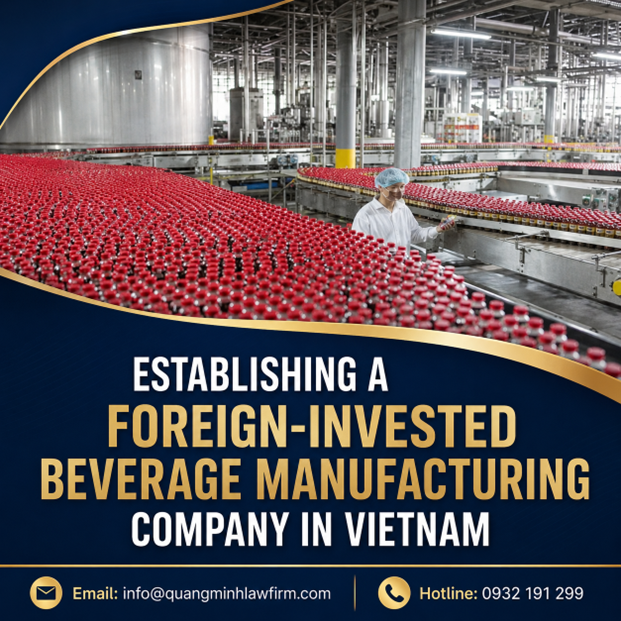
III. FOOD SAFETY, PRODUCT DECLARATION AND LABELING
Beverage manufacturing is a food production activity. Therefore, the company must comply with Vietnam’s food safety regulations. The Law on Food Safety requires food production and trading establishments to have appropriate locations, equipment, water supply, waste treatment systems, storage conditions and procedures to ensure food safety throughout production and circulation.
In most factory-scale beverage manufacturing projects, the company must obtain a Certificate of Food Safety Eligibility before operation, unless it falls under a statutory exemption. Decree No. 15/2018/ND-CP provides guidance on food safety matters, including product self-declaration, registration of product declaration, food safety certificates, food labeling and state inspection of imported and exported foods.
For packaged beverages, the company must also complete product declaration procedures before placing products on the market. Under Decree No. 15/2018/ND-CP, many processed and packaged foods are subject to self-declaration. The dossier generally includes a self-declaration form and a valid food safety testing result issued within the prescribed period. After self-declaration, the company may manufacture and trade the product but remains legally responsible for its safety.
Certain beverage products may be subject to specific national technical regulations. For example, QCVN 6-1:2010/BYT applies to bottled natural mineral water and bottled drinking water, while QCVN 6-2:2010/BYT applies to certain non-alcoholic beverages such as fruit and vegetable juices, nectars and ready-to-drink non-alcoholic beverages.
Product labeling must also be prepared carefully before circulation. Decree No. 111/2021/ND-CP, which amends Decree No. 43/2017/ND-CP on goods labeling, regulates the information that must appear on labels of goods circulated in Vietnam, exported goods and imported goods. For beverage products, mandatory label information commonly includes product name, quantity, ingredients, manufacturing date, expiry date, origin, responsible organization, warning information and instructions for use or storage where applicable.
IV. SPECIAL REQUIREMENTS FOR ALCOHOLIC BEVERAGES
If the foreign-invested company intends to manufacture alcohol, spirits, wine or other alcoholic beverages, additional licensing requirements apply.
Under Decree No. 105/2017/ND-CP, industrial alcohol production is a conditional business activity. A company manufacturing alcohol must be legally established, have machinery, equipment and technological processes suitable for the expected production scale, satisfy food safety requirements, comply with environmental protection regulations, meet labeling requirements and have technical staff with appropriate professional qualifications.
The company must also obtain the relevant alcohol production license before production. The licensing authority and dossier requirements depend on the production scale and type of alcohol business. If the company also distributes, wholesales, retails or sells alcohol for on-premise consumption, additional alcohol business licenses or registration procedures may be required.
Alcoholic beverages are also subject to stricter rules on advertising, promotion, sale to minors and business conduct. The company should review the Law on Prevention and Control of Harmful Effects of Alcoholic Beverages before launching marketing campaigns or distribution programs. In addition, alcohol and beer are generally subject to special consumption tax. Investors should assess tax obligations before finalizing the product structure and pricing model.
V. ENVIRONMENTAL, FIRE SAFETY AND FACTORY OPERATION REQUIREMENTS
A beverage factory may generate wastewater, packaging waste, organic waste, sludge, emissions, noise and industrial cleaning waste. Therefore, environmental compliance should be reviewed at the site-selection stage, not after the factory is built.
The Law on Environmental Protection 2020 regulates environmental impact assessment, environmental licenses, environmental registration, waste management and environmental protection obligations. Depending on the scale, technology and environmental risk of the beverage factory, the project may need an environmental impact assessment report, an environmental license or other environmental procedures before operation.
Fire prevention and firefighting compliance is also important, especially where the factory contains packaging materials, warehouses, electrical systems, boilers, gas systems, CO₂ systems, alcohol storage, chemical cleaning agents or flammable materials. Decree No. 105/2025/ND-CP provides detailed rules for implementing Vietnam’s Law on Fire Prevention, Firefighting, Rescue and Salvage.
Before official operation, the company should also complete post-establishment procedures such as capital contribution, tax registration, e-invoice registration, accounting setup, labor contracts, social insurance registration, work permits for foreign employees, machinery import procedures, product testing records, food safety records, traceability documents and internal quality control procedures.
VI. BASIC PROCEDURE FOR ESTABLISHING A FOREIGN-INVESTED BEVERAGE MANUFACTURING COMPANY
A typical legal roadmap may include the following steps:
Step 1: Review the product and business model.
The investor should identify whether the product is bottled water, mineral water, soft drink, juice, bottled tea, coffee drink, nutritional beverage, beer, wine, spirits or another alcoholic beverage.
Step 2: Check market access and special conditions.
The investor should review whether the product is subject to foreign investment restrictions, food safety conditions, alcohol licensing, technical regulations or other specialized requirements.
Step 3: Select the factory location.
The location must be suitable for beverage production, with proper water supply, wastewater treatment, environmental capacity, fire safety conditions and, where applicable, industrial park approval.
Step 4: Apply for investment registration.
The investor prepares the investment project dossier, including investor documents, financial capacity documents, project proposal, location documents and explanations on production scale and environmental impact.
Step 5: Establish the Vietnamese company.
After completing the investment procedure, the investor obtains the Enterprise Registration Certificate and sets up the project company.
Step 6: Complete factory and operational conditions.
The company prepares the factory, production line, food safety system, environmental procedures, fire safety requirements, machinery import and labor compliance.
Step 7: Obtain food safety and product approvals.
Before commercial sale, the company completes food safety licensing, product testing, self-declaration or registration of product declaration, label review and any alcohol-related license if applicable.
A beverage factory may generate wastewater, packaging waste, organic waste, sludge, emissions, noise and industrial cleaning waste. Therefore, environmental compliance should be reviewed at the site-selection stage, not after the factory is built.
Prospective clients seeking assistance with procedures for setting up a foreign-invested beverage manufacturing company in Vietnam are kindly invited to contact Dai Quang Minh Company via Hotline: 0932 191 299; Zalo: 0932 191 299; Email: info@quangminhlawfirm.com; Viber: (+84) 337 926 405; WhatsApp: (+84) 337 926 405; WeChat: (+84) 337 926 405 (ID: pouniverse) for complimentary consultation and comprehensive, efficient, and accurate legal services.
In addition, Dai Quang Minh Company provides a wide range of services, including sub-licenses, business registration, investment, foreign labor, and ongoing legal advisory services for both domestic and foreign enterprises.
Contact:
- Zalo: 0932.191.299
- Gmail: info@quangminhlawfirm.com
- Viber: (+84) 337926405/ (+84) 869672216
- WhatsApp: (+84) 337926405/ (+84) 869672216
- Wechat: (+84) 337926405 (ID: _pouniverse)/ (+84) 869672216 (ID: DQM_Verna)
- Telegram: (+84) 337926405/ (+84) 869672216
BÀI VIẾT LIÊN QUAN:
Bình luận: