
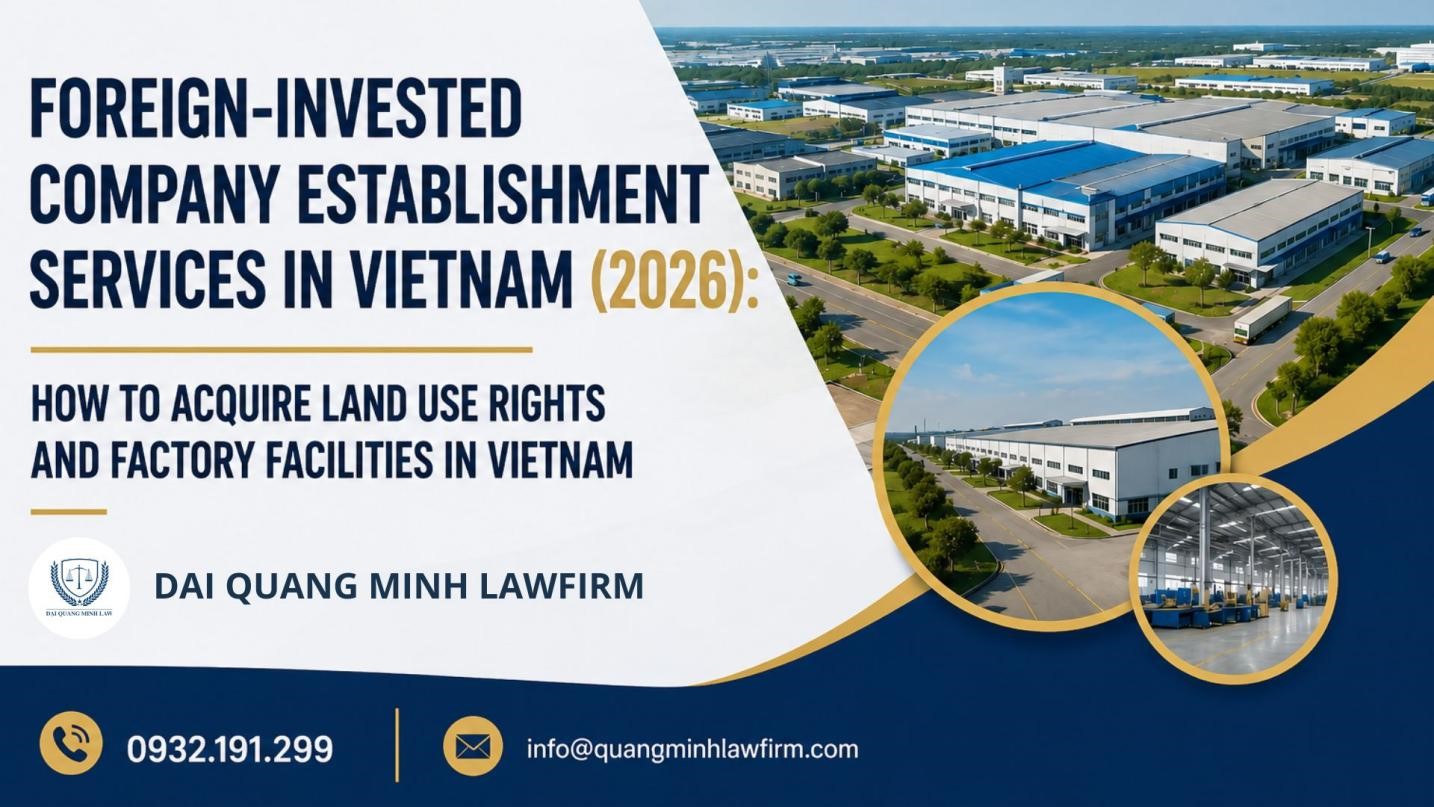
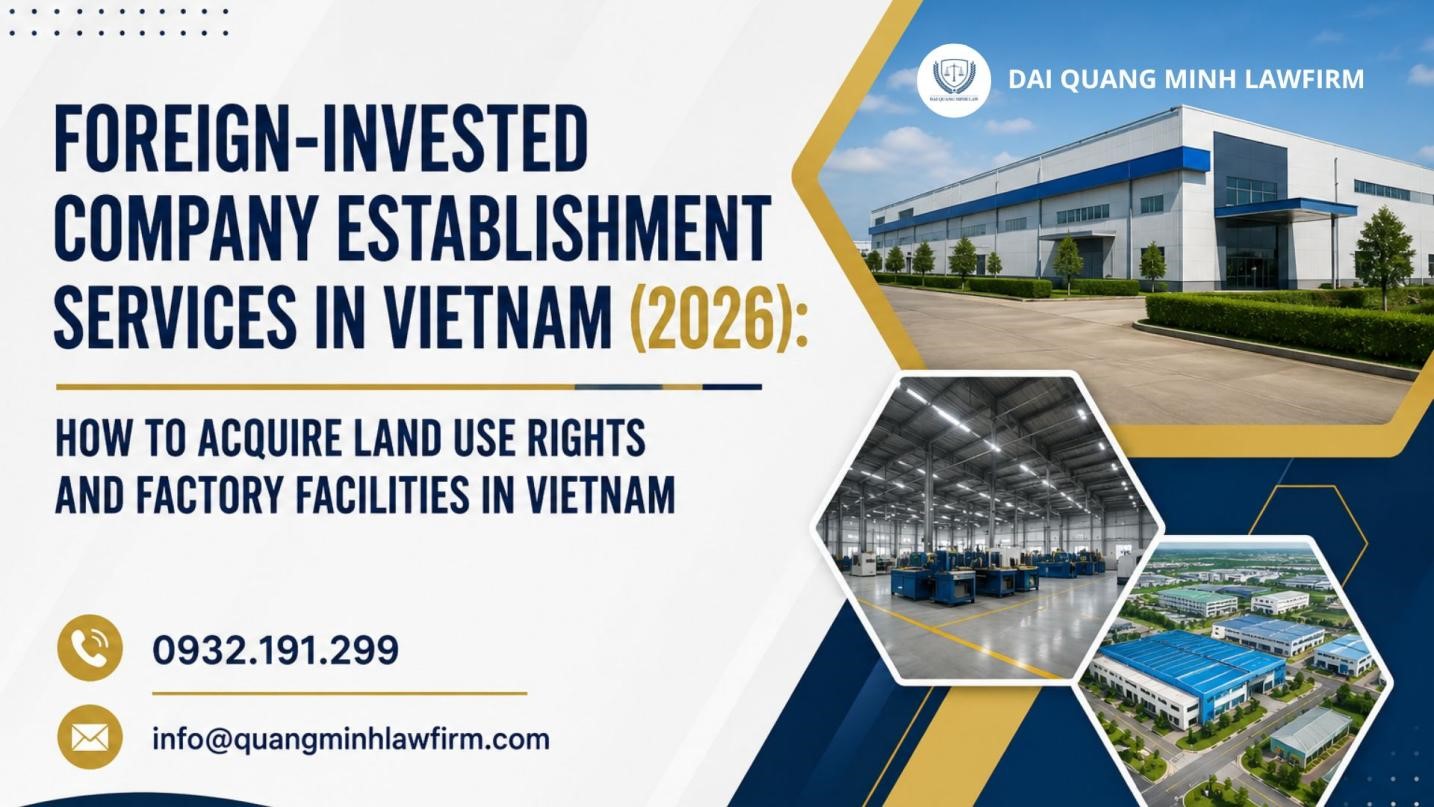
FOREIGN-INVESTED COMPANY ESTABLISHMENT SERVICES IN VIETNAM (2026): HOW TO ACQUIRE LAND USE RIGHTS AND FACTORY FACILITIES IN VIETNAM
Vietnam remains one of the most attractive investment destinations in Southeast Asia, with a rapidly growing industrial sector and an increasingly favorable business environment for foreign investors. Instead of developing a project from the ground up, many investors choose to acquire existing land use rights and factory facilities to save time, reduce investment costs, and accelerate market entry.
However, the acquisition of land and factory assets in Vietnam involves various legal considerations, particularly for foreign-invested enterprises. Investors must carefully assess the legal status of the land, ownership of factory assets, investment conditions, licensing requirements, and compliance obligations before proceeding with a transaction.
This article provides an overview of the legal framework, acquisition methods, key procedures, and practical considerations for foreign investors seeking to acquire land use rights and factory facilities in Vietnam.
Clients interested in support services for establishing a foreign-invested company in Vietnam (2026) may contact Dai Quang Minh Company via Hotline: 0932 191 299; Zalo: 0932 191 299; Email: info@quangminhlawfirm.com; Viber: (+84) 337 926 405; WhatsApp: (+84) 337 926 405; WeChat: (+84) 337 926 405 (ID: pouniverse) for complimentary consultation and comprehensive, efficient, and accurate legal services.
In addition, Dai Quang Minh Company provides a wide range of services, including sub-licenses, business registration, investment, foreign labor, and ongoing legal advisory services for both domestic and foreign enterprises.
Contact:
- Zalo: 0932.191.299
- Gmail: info@quangminhlawfirm.com
- Viber: (+84) 337926405/ (+84) 869672216
- WhatsApp: (+84) 337926405/ (+84) 869672216
- Wechat: (+84) 337926405 (ID: _pouniverse)/ (+84) 869672216 (ID:DQM_Verna)
- Telegram: (+84) 337926405/ (+84)869672216
I. Vietnam's investment landscape and legal framework
Unlike many countries where land can be fully owned, in Vietnam, land is collectively owned by the people and managed by the state on their behalf. Consequently, foreign investors cannot possess land outright but can acquire land use rights, which are granted under specific legal frameworks.
Foreign investors must obtain several critical licenses and approvals to ensure compliance with Vietnamese law. Key among these are the Investment Registration Certificate (IRC) and the Business Registration Certificate (BRC).
The Investment Registration Certificate is a mandatory document that foreign investors need to establish any business venture in Vietnam. This certificate is issued by the Department of Planning and Investment (DPI) or by the Industrial Park Management Board if the project is registered in industrial parks within the province where the investment will take place. The IRC specifies the project’s scope, objectives, and investment capital, ensuring that the foreign investment aligns with national and regional economic goals.
Once the IRC is secured, investors must obtain a Business Registration Certificate. The BRC, also issued by the DPI, legally formalizes the business entity, enabling it to operate in Vietnam. This certificate includes crucial details such as the company's name, business activities, and headquarters location. Together, the IRC and BRC form the foundation of legal compliance for foreign investments in Vietnam.

II. Structure of land use rights
Land use rights are formalized through a Land Use Rights Certificate (LURC), which documents the user’s legal rights to utilize the land. Foreign investors can secure these rights for up to 50 years, with the possibility of a one-time extension for another 50 years, contingent upon compliance with the terms set forth in the LURC.
Foreign investors typically encounter two primary land use arrangements:
- Annual Rent Payment: Under this arrangement, the land is leased with an annual rent payment. The investor can utilize the land for the specified purposes but has limited rights regarding transferring or subleasing the land.
- One-Time Payment: This option involves paying the lease amount upfront. It grants broader rights, including the ability to transfer, sublease, or mortgage the land and associated assets. Additionally, this arrangement allows the investor to contribute the LURC as capital to a joint venture.

III. Why choose Dai Quang Minh Company
With years of practical experience in legal consulting, Dai Quang Minh Company is a pioneer in corporate support services, specializing in fast and affordable company formation. Below are the reasons to choose business registration services at Dai Quang Minh Company:
Human Resources: Gather a team of corporate legal experts and project legal experts with a long working history at domestic private economic groups; large foreign-invested enterprises operating in Vietnam...
Consulting Policy: Clients are gifted a completely free legal consulting package when using services at Dai Quang Minh Company.
Professionalism and Experience: Dai Quang Minh Company has a workforce with in-depth knowledge of business formation, ensuring a swift and accurate consulting process.
Time-Saving: Using Dai Quang Minh Company's services helps you save precious time as we handle the entire process and related procedures.
Legal Insight: Dai Quang Minh Company ensures that all relevant legal regulations are strictly followed in accordance with the law.
Customization: Our consulting services are highly adaptable to your specific needs, allowing you to choose options suitable for your business.
Trusted Partner: Dai Quang Minh Company has built a reputation for providing affordable business setup consulting to many enterprises and individuals nationwide.
Confidentiality Assurance: Dai Quang Minh Company is committed to the absolute protection of your personal and business information.
Detailed Support: Dai Quang Minh Company provides detailed advice and support regarding the process and requirements to help you better understand business formation.
Process Optimization: Our consulting helps optimize the business setup process, minimizing potential risks and difficulties.
Excellent Customer Experience: Dai Quang Minh Company is dedicated to providing the best customer experience through professional advice and enthusiastic support.
Focus on Business Plans: By utilizing our registration services, you can focus on developing your business plans and core activities instead of worrying about legal procedures.
IV. Types of properties available to foreign investors
Foreign investors can access various types of properties in Vietnam, each with specific regulations:
Residential properties
While foreign individuals can own residential properties, there are restrictions on the proportion of units they can own within a building or a specific geographical area. As per the Housing Law No. 65/2014/QH13, foreigners can own up to 30 percent of the apartments in a building or a maximum of 250 houses in an administrative ward.
Commercial and industrial properties
Foreign investors can lease land in industrial zones, economic zones, high-tech zones, and export-processing zones. Leasing from a landlord who has already secured land use rights in these zones is often the most straightforward method, as the necessary administrative procedures have typically been completed
V. Acquiring land use rights methods
Investors have several options to acquire land use rights in Vietnam:
Government allocation
The state allocates land use rights through an administrative decision. Investors pay land use fees for residential and infrastructure projects.
Direct leasing from the Government
The government leases land directly to users, who can opt to pay the rent either annually or as a lump sum.
Sub-leasing in industrial zones
Leasing land from landlords in designated zones such as industrial or economic zones. This method is preferred due to pre-completed legal and procedural compliance by the landlord.
Transfer of Land Use Rights
Investors can acquire land use rights through agreements with existing land users, involving the transfer of assets attached to the land.
Legal and regulatory considerations
The legal framework governing land use in Vietnam is extensive and includes several key regulations:
- Law on Land (2024) outlines the general principles, rights, and responsibilities associated with land use in Vietnam.
- Housing Law specifies the conditions under which foreigners can own residential properties.
- Investment Law provides guidance on the involvement of foreign entities in land use and ownership.
The 2024 Vietnam Land Law is set to be enacted on January 1, 2025, formally superseding the 2013 version, known as Land Law No. 45/2013/QH13. However, certain provisions will come into effect earlier:
- Article 190: Regulations related to maritime encroachment activities took effect in April 2024.
- Article 248: Amendments to several articles of the Law on Forestry are also took effect in April 2024.
- Article 60.9: Regulations regarding the development and approval of land use planning will be effective from the expiration date of Resolution No. 61/2022/QH15, which was adopted by the National Assembly (NA) on June 16, 2022.
VI. Practical steps for land and factory acquisition
Market research
The journey begins with comprehensive market research, where investors assess potential locations, evaluate market trends, and identify suitable properties.
Utilizing online resources, engaging local real estate agents, and consulting with industry experts can provide valuable insights into the Vietnamese property market.
Property type selection
Once potential properties are identified, the next step is selecting the appropriate type of property whether it be ready-built factories, built-to-suit factories, or industrial land based on the specific needs of the business.
Foreign investors have various options when it comes to industrial properties in Vietnam, each offering distinct strategic benefits and potential drawbacks.
- Ready-Built Factories are pre-constructed facilities available for immediate use, providing a quick and cost-effective solution for businesses looking to start operations swiftly. The primary advantage of ready-built factories is the reduced time and capital expenditure required to begin production. However, the flexibility to customize these facilities is limited, which might not meet the specific needs of all businesses.
- Built-to-Suit Factories are custom-built to meet the specific requirements of the investor. Built-to-suit factories offer the highest level of customization, ensuring that the facility aligns perfectly with the operational needs of the business. This option often results in greater operational efficiency and effectiveness. The main drawback is the longer development time and potentially higher initial costs compared to ready-built factories.
- Industrial Land allows investors to construct their facilities from scratch, providing maximum flexibility and control over the design and layout. This option is ideal for companies with unique requirements or large-scale production needs. However, acquiring industrial land involves complex regulatory approvals and longer development timelines, which can delay the commencement of operations.
Negotiation and securing Land Use Rights
Following type selection, the negotiation phase begins, where terms and conditions are agreed upon with the property owner. This is followed by securing land use rights, which involves obtaining a Land Use Rights Certificate (LURC) through one of several methods, such as government allocation, direct leasing, sub-leasing from industrial zones, or transferring existing land use rights.
Obtain construction permits
The first critical step is obtaining construction permits, which requires submitting detailed plans and documents to the local authorities. This process ensures that the proposed construction complies with all regulatory requirements and safety standards.
Build infrastructure
the next phase involves building the necessary infrastructure, including utilities, access roads, and essential facilities. Engaging reliable contractors and project managers can help streamline this phase, ensuring timely and cost-effective completion of construction.
Project acceptance
Once the factory construction is completed, the investor must arrange for an inspection by relevant Vietnamese authorities. This inspection ensures that the construction complies with the approved design, building codes, environmental regulations, and safety standards.
Staff recruitment
Depending on the factory's operations, this process may involve hiring skilled workers, administrative staff, and management personnel. Establishing a robust recruitment strategy, possibly in collaboration with local employment agencies, can help attract qualified candidates.
VII. Common challenges faced by foreign investors
Foreign investors in Vietnam often encounter a range of challenges, primarily stemming from bureaucratic hurdles and legal complexities. Navigating the intricate legal landscape can be daunting, with various regulations governing land use, property ownership, and business operations.
The process of obtaining necessary permits and approvals, such as the Investment Registration Certificate (IRC) and the Business Registration Certificate (BRC), can be time-consuming and requires thorough documentation. Additionally, language barriers and differences in business practices can further complicate the investment process.
Strategies to overcome challenges
To successfully navigate these challenges, foreign investors can adopt several effective strategies:
- Proper planning
+ Conduct comprehensive market research and due diligence to understand local regulations and market conditions.
+ Develop a detailed investment plan that outlines the steps required for land acquisition and factory establishment, including timelines and budget considerations.
- Local partnerships
+ Establish partnerships with local businesses or individuals who have a deep understanding of the local market and regulatory environment. These partners can provide valuable insights and assist in navigating bureaucratic processes.
+ Consider forming joint ventures with reputable local companies to leverage their existing relationships and experience in the market.
Prospective clients seeking assistance with procedures for establishing a foreign-invested company in Vietnam (2026) are kindly invited to contact Dai Quang Minh Company via Hotline: 0932 191 299; Zalo: 0932 191 299; Email: info@quangminhlawfirm.com; Viber: (+84) 337 926 405; WhatsApp: (+84) 337 926 405; WeChat: (+84) 337 926 405 (ID: pouniverse) for complimentary consultation and comprehensive, efficient, and accurate legal services.
In addition, Dai Quang Minh Company provides a wide range of services, including sub-licenses, business registration, investment, foreign labor, and ongoing legal advisory services for both domestic and foreign enterprises.
Contact:
- Zalo: 0932.191.299
- Gmail: info@quangminhlawfirm.com
- Viber: (+84) 337926405/ (+84) 869672216
- WhatsApp: (+84) 337926405/ (+84) 869672216
- Wechat: (+84) 337926405 (ID: _pouniverse)/ (+84) 869672216 (ID: DQM_Verna)
- Telegram: (+84) 337926405/ (+84) 869672216
BÀI VIẾT LIÊN QUAN:
Bình luận: